
Neurofeedback · Basel · English
Neurofeedback in Basel: gentle training for your nervous system
Gentle, medication-free brain training for inner calm and focus. Please don't worry if your German is limited: many of my clients speak only a little, and we simply switch to English, French or Italian when needed.
Introduction
What happens during neurofeedback
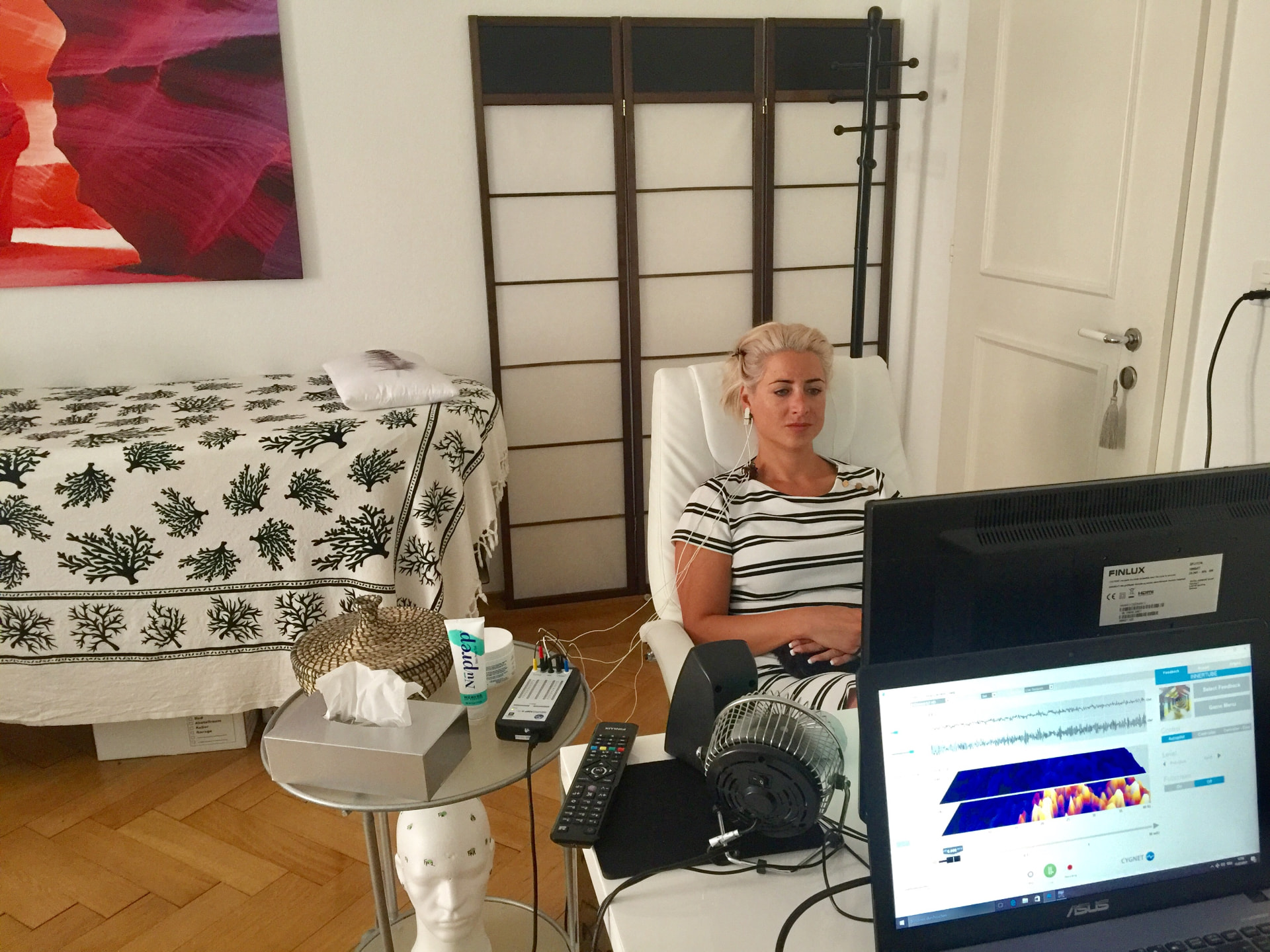
Neurofeedback is like fitness training for your brain. A gentle method that helps your nervous system find its way back to its own balance.
Small sensors on your head measure the tiny, natural rhythms of your brain. No electricity flows into your head, and you don't have to make any effort.
I will guide you personally in my practice in Basel.
Process
How your neurofeedback training works
Free introductory call
A short phone call of about 10–15 minutes to answer your questions and see how easily we understand each other. Free and without obligation.
First session
85 minutes including case history for CHF 225: We get to know your concerns and your background.
Follow-up sessions
55 minutes, CHF 150: 20 to 30 minutes on the device, the rest for conversation and coaching, where we look at what has changed and what we can adjust.
Rhythm
Once a week is recommended, adapted individually to your situation.
Your feedback counts
In the early sessions, your feedback helps me fine-tune the training to you.
With neurofeedback, the brain learns through repetition (neuroplasticity). With training, the new pathways strengthen until self-regulation becomes more and more stable. How many sessions make sense for you is something we discuss together, at your own pace.
Experiences
What clients report
“Hello Pascale, last night I slept better than I have in a long time! I woke up this morning after 7 hours of sleep feeling very rested, and my head felt so light and calm. Even now I am still clear and focused.”
“Since I started training with neurofeedback, I can read again (before, I always drifted off). My concentration has improved noticeably, and I can now remember much better what I have read. This helps me a lot in preparing for my exams.”
“After the neurofeedback I felt an incredible calm inside me again, which lasted for days. My migraine attacks are clearly decreasing and the intervals are getting longer and longer.”
“Hello Pascale, over the last few days M. got angry much less quickly, asked me for help a few times and is more affectionate overall. The head-shaking tic is suddenly gone.”
Translated from German and anonymised. Individual client experiences; neurofeedback supports self-regulation and does not replace medical treatment.
Method
How neurofeedback works
The Othmer method (ILF, infra-low frequency)
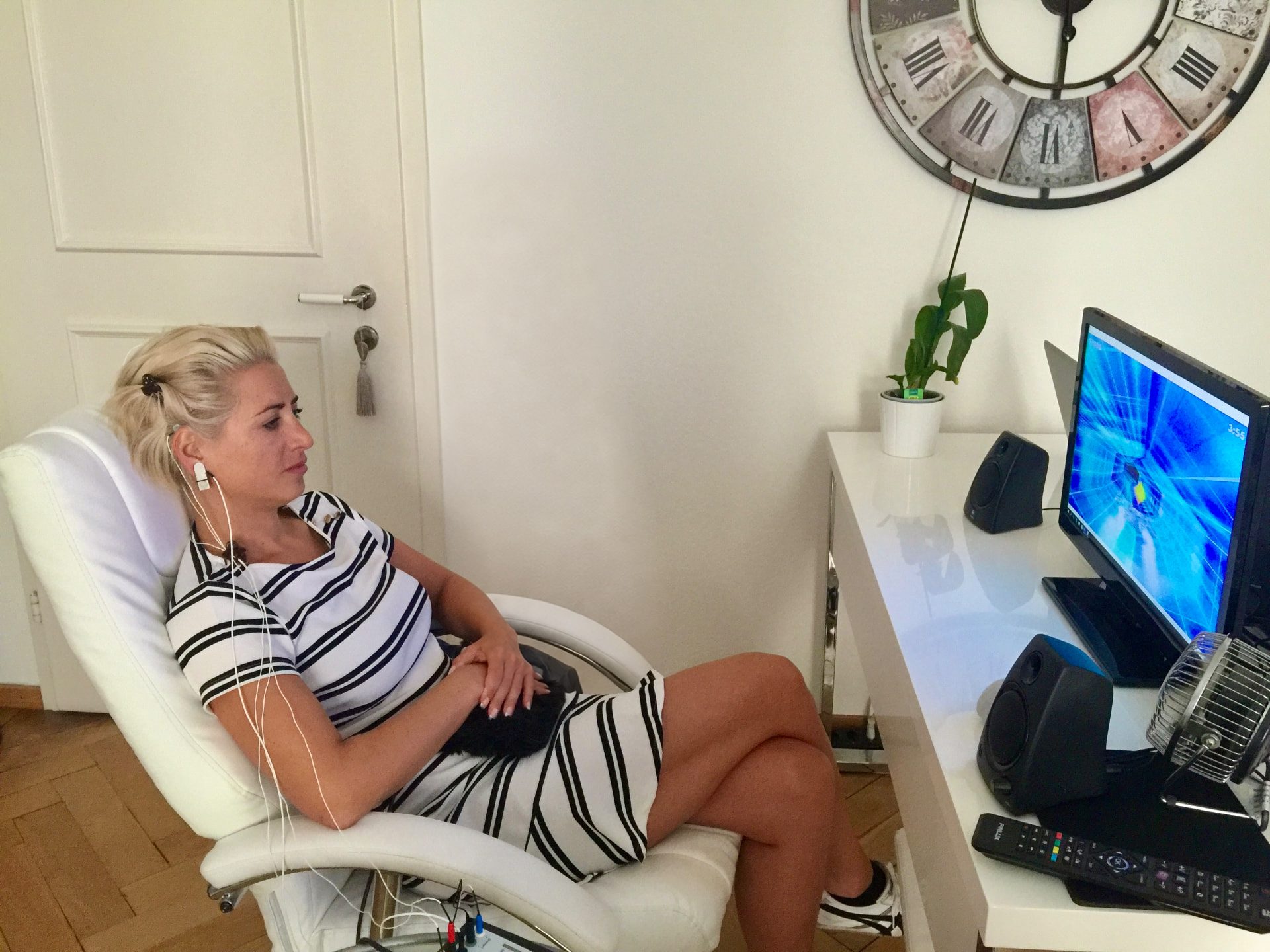
On the screen you see a moving picture, such as a film or a graphic, that changes instantly depending on what your brain is doing. Sounds and a gentle humming, a bit like a purring cat, are added.
These signals act like a constant mirror for your nervous system. When your brain finds better balance, the film runs more clearly. Your brain notices this difference and learns by itself to find its way back to this state more easily, without any willpower.
I work with ILF neurofeedback based on the approach of Susan and Siegfried Othmer. Instead of a rigid scheme, the training frequencies are adjusted individually to your nervous system in every session.
Topics
When neurofeedback can support you
Burnout, stress & exhaustion
When your nervous system is stuck in permanent overdrive and rest no longer brings recovery.
ADHD & focus: adults and children
For inner restlessness, sensory overload and the effort it takes to stay on task.
Sleep & racing thoughts
When sleep won't come because the mind keeps circling.
Anxiety & inner restlessness
When your system reacts strongly to stress signals and inner safety feels out of reach.
High sensitivity & overload
For finely tuned minds that take in a lot and need a steadier inner filter.
Chronic pain & tension
As gentle support when tension and pain keep your nervous system on alert.
Focus & mental clarity
Staying centred and composed under pressure at work, in studies or on stage.
Questions
What you may want to know
Is neurofeedback painful or uncomfortable?
Not at all. The small sensors simply listen, like a tiny microphone. No electrical current enters your head. You relax comfortably in an armchair, listen to music or watch a film. Because no active effort is required, even children enjoy the training.
Do I need to be fluent in German?
No. Please don't worry about your German. Many of my clients only speak a little German, and we simply mix in English, French or Italian whenever needed. During the training itself, your brain learns directly from the screen, without the need for many words.
Does it involve medication?
No, neurofeedback is medication-free. If you already take medication prescribed by your doctor, neurofeedback can be done alongside it. Any change in medication should always be discussed with your physician.
How many sessions will I need?
This is very individual and depends on your situation, so we discuss it together. Some clients notice first changes, such as calmer sleep, within the first sessions. Because the brain learns through repetition, several sessions are needed for the new stability to settle in.
Is it scientifically researched?
I work with ILF neurofeedback, which has been examined in a growing number of studies, most of them observational. In a multicentre observational study with 251 children, adolescents and young adults with ADHD, attention and impulse control improved significantly.